






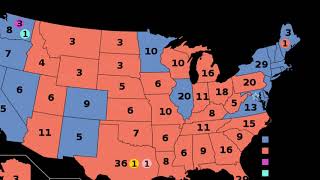




THE U.S. ELECTORAL COLLEGE -DEMOCRACY? YES or NO?
- Apr 12, 2019
- 5 min read
What is the Electoral College? According to archives.gov/federal-register
The Electoral College is a process, not a place. The founding fathers established it in the Constitution as a compromise between election of the President by a vote in Congress and election of the President by a popular vote of qualified citizens.
The Electoral College process consists of the selection of the electors, the meeting of the electors where they vote for President and Vice President, and the counting of the electoral votes by Congress.
The Electoral College consists of 538 electors. A majority of 270 electoral votes is required to elect the President. Your state’s entitled allotment of electors equals the number of members in its Congressional delegation: one for each member in the House of Representatives plus two for your Senators.
Under the 23rd Amendment of the Constitution, the District of Columbia is allocated 3 electors and treated like a state for purposes of the Electoral College. For this reason, in the following discussion, the word “state” also refers to the District of Columbia.
Each candidate running for President in your state has his or her own group of electors. The electors are generally chosen by the candidate’s political party, but state laws vary on how the electors are selected and what their responsibilities are. Read more about the qualifications of the Electors and restrictions on who the Electors may vote for.
The presidential election is held every four years on the Tuesday after the first Monday in November. You help choose your state’s electors when you vote for President because when you vote for your candidate you are actually voting for your candidate’s electors.
Most states have a “winner-take-all” system that awards all electors to the winning presidential candidate. However, Maine and Nebraska each have a variation of “proportional representation”.
After the presidential election, your governor prepares a “Certificate of Ascertainment” listing all of the candidates who ran for President in your state along with the names of their respective electors. The Certificate of Ascertainment also declares the winning presidential candidate in your state and shows which electors will represent your state at the meeting of the electors in December of the election year. Your state Certificates of Ascertainment's are sent to the Congress and the National Archives as part of the official records of the presidential election. See the key dates for the 2016 election and information about the roles and responsibilities of state officials, the Office of the Federal Register and the National Archives and Records Administration (NARA), and the Congress in the Electoral College process.
The meeting of the electors takes place on the first Monday after the second Wednesday in December after the presidential election. The electors meet in their respective states, where they cast their votes for President and Vice President on separate ballots. Your state’s electors’ votes are recorded on a “Certificate of Vote,” which is prepared at the meeting by the electors. Your state’s Certificates of Votes are sent to the Congress and the National Archives as part of the official records of the presidential election.
Each state’s electoral votes are counted in a joint session of Congress on the 6th of January in the year following the meeting of the electors. Members of the House and Senate meet in the House chamber to conduct the official tally of electoral votes.
The Vice President, as President of the Senate, presides over the count and announces the results of the vote. The President of the Senate then declares which persons, if any, have been elected President and Vice President of the United States.
The President-Elect takes the oath of office and is sworn in as President of the United States on January 20th in the year following the Presidential election.
According to Wikipedia, The United States Electoral College is a body of electors established by the United States Constitution, constituted every four years for the sole purpose of electing the president and vice president of the United States. The Electoral College consists of 538 electors, and an absolute majority of 270 electoral votes is required to win an election. Pursuant to Article II, Section 1, Clause 2, the legislature of each state determines the manner by which its electors are chosen.
Each state's number of electors is equal to the combined total of the state's membership in the Senate and House of Representatives; currently there are 100 senators and 435 representatives. Additionally, the Twenty-third Amendment provides that the District of Columbia (D.C.) is entitled to a number of electors no greater than that of the least populous state.
Following the national presidential election day in the first week of November, each state counts its popular votes pursuant to that state's laws to designate presidential electors. Most all states allot all their electoral votes to the winning candidate in that state, no matter how marginal the candidate's win. State electors meet in their respective state capitals in December to cast their votes. The results are certified by the states and D.C. to Congress, where they are tabulated nationally in the first week of January before a joint meeting of the Senate and House of Representatives.
If a majority of votes are not cast for a candidate, the House resolves itself into a presidential election session with one presidential vote assigned to each of the fifty state delegations, excluding the District of Columbia. The elected president and vice president are inaugurated on January 20. While the electoral vote has given the same result as the popular vote in most elections, this has not been the case in a few elections, including the 2000 and 2016 elections.
The Electoral College system is a matter of ongoing debate, with some defending it and others calling for its abolition. Supporters of the Electoral College argue that it is fundamental to American federalism, that it requires candidates to appeal to voters outside large cities, increases the political influence of small states, discourages the excessive growth of political parties and preserves the two-party system, and makes the electoral outcome appear more legitimate than that of a nationwide popular vote.
Opponents of the Electoral College argue that it can result in a person becoming president even though an opponent got more votes (which occurred in two of the five presidential elections from 2000 to 2016); that it causes candidates to focus their campaigning disproportionately in a few "swing states" while ignoring most areas of the country; and that its allocation of Electoral College votes gives citizens in less populated states (e.g. Wyoming) as much as four times the voting power as those in more populous states (example California). Most polls since 1967 have shown that a majority of Americans favor the president and vice president being elected by the nationwide popular vote.
Five times a candidate has won the popular vote and lost the election. Andrew Jackson in 1824 (to John Quincy Adams); Samuel Tilden in 1876 (to Rutherford B. Hayes); Grover Cleveland in 1888 (to Benjamin Harrison); Al Gore in 2000 (to George W. Bush); Hillary Clinton in 2016 (to Donald J. Trump).
Comments